RYA Powerboat Level 2
Some may know I was press-ganged late last year into joining Chris at Mutiny Diving as a trainee skipper. I now have my RYA Powerboat Level 2 commercially endorsed. The next big step is RYA Yachtmaster Coastal Motor.
The limitation with a commercially endorsed Powerboat Level 2 is fairly simple. I can work commercially on vessels up to 24 m in Category 6 waters. That means up to 3 nautical miles from a nominated departure point, in fine weather and daylight. Useful for White Cliffs scenic trips and local fishing. Less useful for proper Dover wreck diving, unless everyone fancies diving beige soup near Samphire Hoe. The RYA sets out those Powerboat Level 2 commercial limits clearly.
So these ten days with Chris and Maverick were not a jolly. Well, not entirely. They were about adding sea hours and miles. They were about getting hands-on with the nitty-gritty of dive planning, diver management, Channel VTS, shot work, recovery, and the small matter of not letting yachts wander through a live dive site like confused pensioners in Waitrose.
The longer-term aim is RYA Yachtmaster Coastal Motor. For that, the RYA requires documented sea time on suitable vessels, including 30 days at sea, 2 days as skipper, 800 miles, and 12 night hours, with at least half the qualifying sea time in tidal waters. So yes, there is a plan. Terrifying, I know.
What improved?
VHF work has become more natural. General boat handling has improved.
Shotting UB-55 midships felt like a proper milestone.
Confidence with diver recovery has grown. I’m also getting more comfortable with the navigation systems and radar, which is handy when your workplace is the Dover Strait and every screen seems to be telling you that a ferry, yacht, fishing boat or floating mystery object has decided to join the party.
What still needs work?
Plenty. Compass bearings need sharpening. Boat movement and positioning at speed need more practice. Port and Channel communications still need bedding in. Shot recovery needs work.
And, inevitably, I need to keep improving the ability to make quick decisions without looking like a man trying to remember where he left his glasses.
There is a lot to learn. That is the point.

The serious bit: Dover is not a duck pond
Dover wreck diving sits in a very particular maritime environment. The Dover Strait is one of the busiest stretches of water in the world. It has commercial shipping, ferries, fishing vessels, recreational craft, tides, banks, wrecks, visibility issues, and enough moving parts to keep any skipper honest.
This is where COLREGs matter.
COLREGs are the International Regulations for Preventing Collisions at Sea. They are not decorative paperwork. They are the rules that stop vessels becoming expensive metal origami. For Dover, Rule 10 matters because it deals with Traffic Separation Schemes. MGN 364 Amendment 2, published by the Maritime and Coastguard Agency on 3 December 2024, gives specific guidance on Rule 10 and navigation in the Dover Strait. It also includes important guidance on recreational diving in UK Traffic Separation Schemes.
The key dive-related points are worth spelling out.
The MCA does not recommend recreational diving within a UK Traffic Separation Scheme because it creates hazards for both shipping and divers. Dive support vessels in a lane must proceed in the general direction of traffic flow. If they are under 20 m, they must not impede the safe passage of a power-driven vessel following the lane. They should not anchor in the lane. Divers are also reminded that deep-draught and high-speed ships may struggle to detect typical diving surface marker buoys at distance. That matters when a ship draws more than 10 m and a diver is hanging around doing decompression above that depth like a small, optimistic sausage.
Masters of dive support craft in the Dover Strait should advise Channel VTS of their intentions. That promotes diving safety and allows VTS to offer safety advice where available.
That is why Chris takes the briefings seriously. That is why the Coastguard gets the dive report. That is why divers are expected to follow the plan. And that is why “I’ll pop up wherever I fancy under a DSMB” is not always a clever idea in this part of the world. The sea does not care how many dives you have logged. The ship bearing down on your little orange blob cares even less.
Lessons from two yachts
Two incidents stood out. Both involved yachts. Now, before the yacht people start polishing their brass outrage horns, this is not an anti-yacht rant. Plenty of sailors are excellent seafarers. Some, though, appear to navigate using vibes, sandwiches and spiritual guesswork.
Yacht one: constant bearing, decreasing range
One sharp reminder came while we were underway on Maverick.
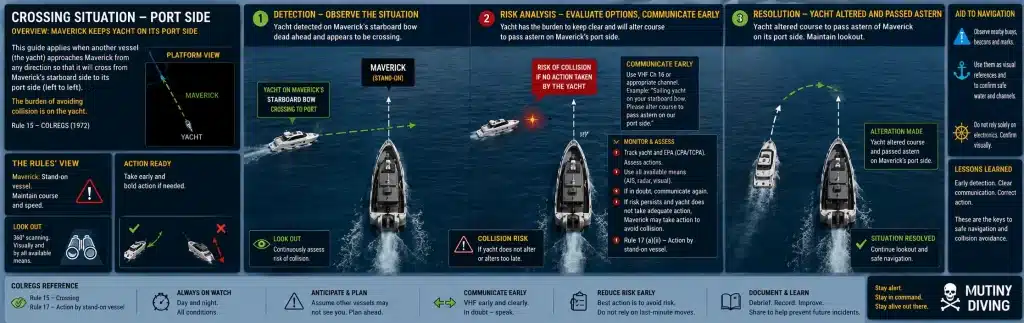
Rob spotted a yacht under engine on the plotter. AIS gave us the vessel name, so there was no confusion about who we were watching. It was crossing from our port side and looked set to pass ahead. The bearing stayed steady. The range kept closing. That is the classic warning sign: constant bearing, decreasing range.
In plain English, if another vessel stays in the same place relative to your window but keeps getting bigger, you may be about to become part of each other’s day.
Rob called the yacht on Channel 16 by name. No response. He called again. Still nothing.
Under COLREG Rule 15, when two power-driven vessels are crossing and risk of collision exists, the vessel with the other on her own starboard side must keep out of the way and, where circumstances allow, avoid crossing ahead.
The yacht was under engine, so for this purpose it was a power-driven vessel. It should have given way. Instead, it carried on until the whole thing became far too close for comfort. Then came the horn blasts, shouting and hand gestures, the ancient maritime dialect of “stop pointing that thing at us.”
Eventually, they altered and passed astern.
The yacht was flying the Stars and Stripes, which added a bit of theatre, but the lesson had nothing to do with nationality.
AIS helps. VHF helps. Neither replaces a proper lookout.
MGN 364 also reminds mariners in and near Traffic Separation Schemes of the importance of Rules 5, 6, 7 and 8: lookout, safe speed, risk of collision, and action to avoid collision.
Rob stayed calm, kept assessing the risk, and made sure Maverick stayed safe. For me, it was a useful reminder that skippering is not only about wrecks, tides and shot lines. Sometimes it is about spotting trouble early, acting clearly, and assuming the other helm may be busy doing absolutely anything except helming.
Yacht two: six divers below
If the first yacht was annoying? The second one was dangerous.
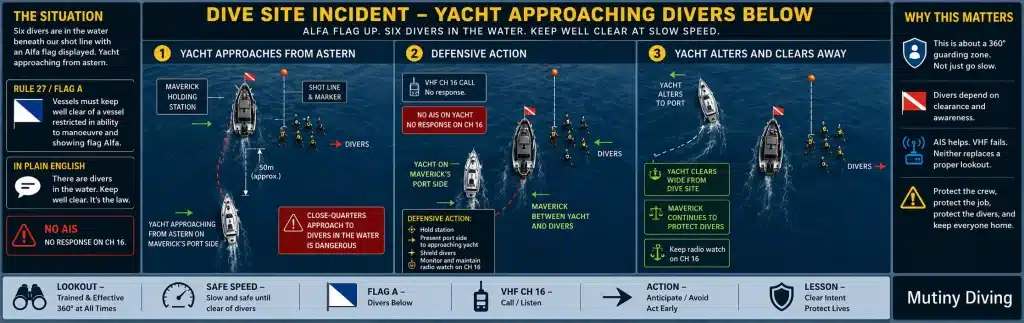
This time we had six divers in the water. The Coastguard had the dive report. Maverick had the Alfa flag up: divers below, keep well clear at slow speed.
Under COLREG Rule 27, where the size of a vessel engaged in diving operations makes it impractical to show all the prescribed lights and shapes, a rigid replica of International Code Flag A, at least 1 m high, should be displayed with all-round visibility.
In normal human terms: there are divers in the water, do not come charging through. Chris told me to keep an eye on a yacht astern. It was under sail. It was closing fast. And it was heading straight for us. This one had no AIS, so we had no vessel name to call. We tried Channel 16 anyway. No answer. Again. With divers below us, this was no time for polite optimism.
Chris took a defensive stance. He put Maverick head-to-head, making the situation impossible for the yacht to ignore. Maverick was between the shot and the yacht. Once they altered, Chris turned and powered on their starboard side, keeping them on our port side and pushing them north, away from the divers.
There was shouting. There were hand signals. And yes, there were some well-dressed Sunday sailors receiving a practical lesson in why dive flags are not decorative bunting. It worked. The yacht cleared away from the dive site.
For me, that was the sharper lesson of the trip. When divers are in the water, the skipper is not guarding a boat. He is guarding lives. If another vessel ignores the flag, ignores the radio, and keeps coming, calm firmness stops being optional.
What I learned about divers from the wheelhouse
As a diver myself, I now see the problem from the other side. We are needy.
- “What time are we off?”
- “What’s the dive time?”
- “What depth is it?”
- “What’s the visibility?”
- “I forgot my reel, do you have one Chris?”
- “Mark, where can I put my bag?”
- “Chris, this?”
- “Mark, that?”
- “Chris, the other?”
It is enough to make you pull your hair out, assuming the sea has left you any. But there is a serious point hiding under the grumbling. From the wheelhouse, diver behaviour matters. Small things make recovery easier. Small things make deployment smoother. Small things reduce risk. And small things, ignored often enough, become big things with paperwork attached. Nobody wants paperwork. Especially paperwork involving the words “incident”, “investigation” or “why was Barry found underneath Derek?”
Diver recovery: what helps from the water
These are the practical lessons I took from Maverick’s recovery setup. They are not meant to replace a skipper’s briefing. They support it. Listen to the skipper. Listen to the crew. Then do what you were briefed to do. Humanity has tried improvisation. Results vary.
There is a big bobber at the top of the shot and a small bobber connected by a tail rope. The tail bobber will be down tide. Ascend to the big bobber. Hold the tail rope gently at arm’s length. Drift off towards the small bobber. The skipper will position Maverick between the small bobber and you. You can then swim to the safety line and lift. Simple. Elegant. Utterly ruined if everyone invents their own version.
You are already a moving target. Swimming at the boat does not usually help. It may tire you. It may make your movement harder to predict. Let the boat come to you. This is hard for divers because we are trained to feel useful by finning. Sometimes the most useful thing is to float there calmly and resist the urge to perform aquatic interpretive dance.
If you surface as a buddy pair, team or group, stay together. Trying to recover a scattered group of divers is like picking up a strike of skittles in a washing machine. The skipper wants one target, not six independent life choices.
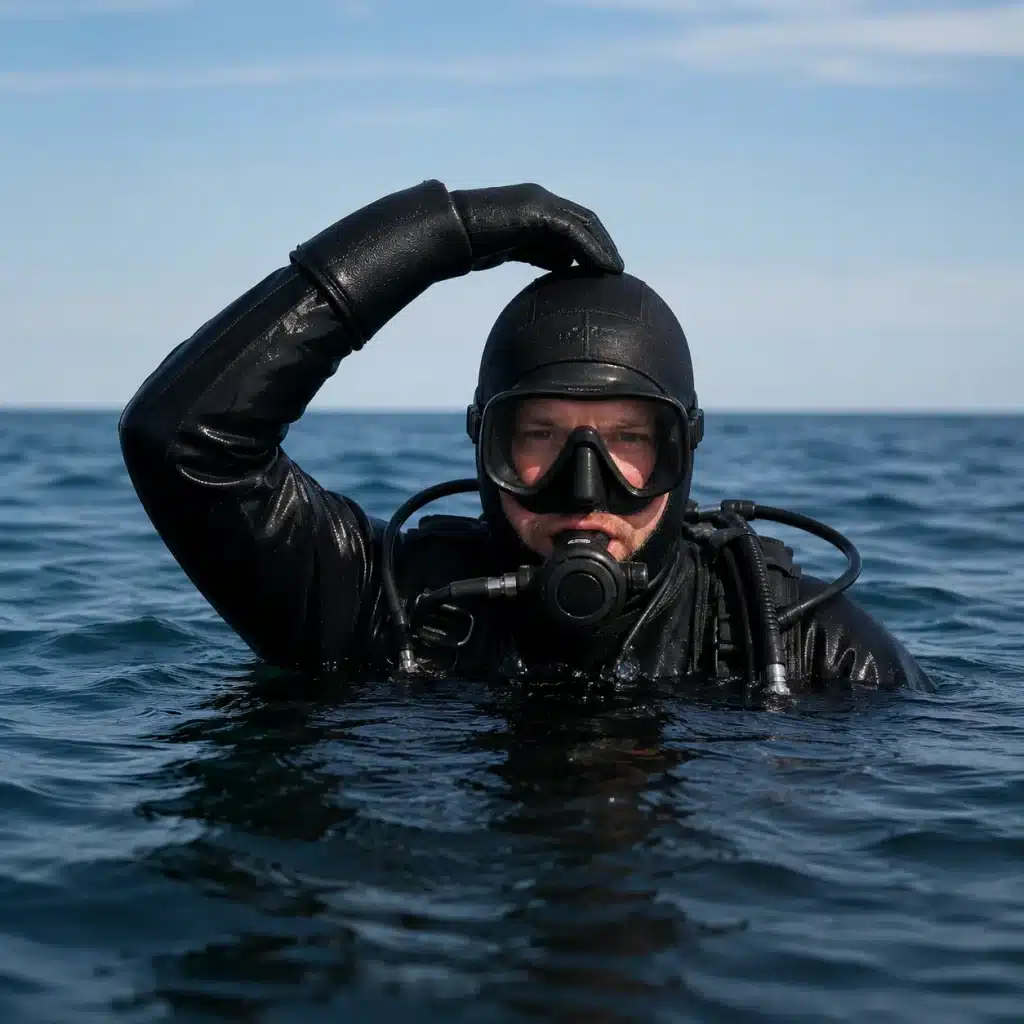
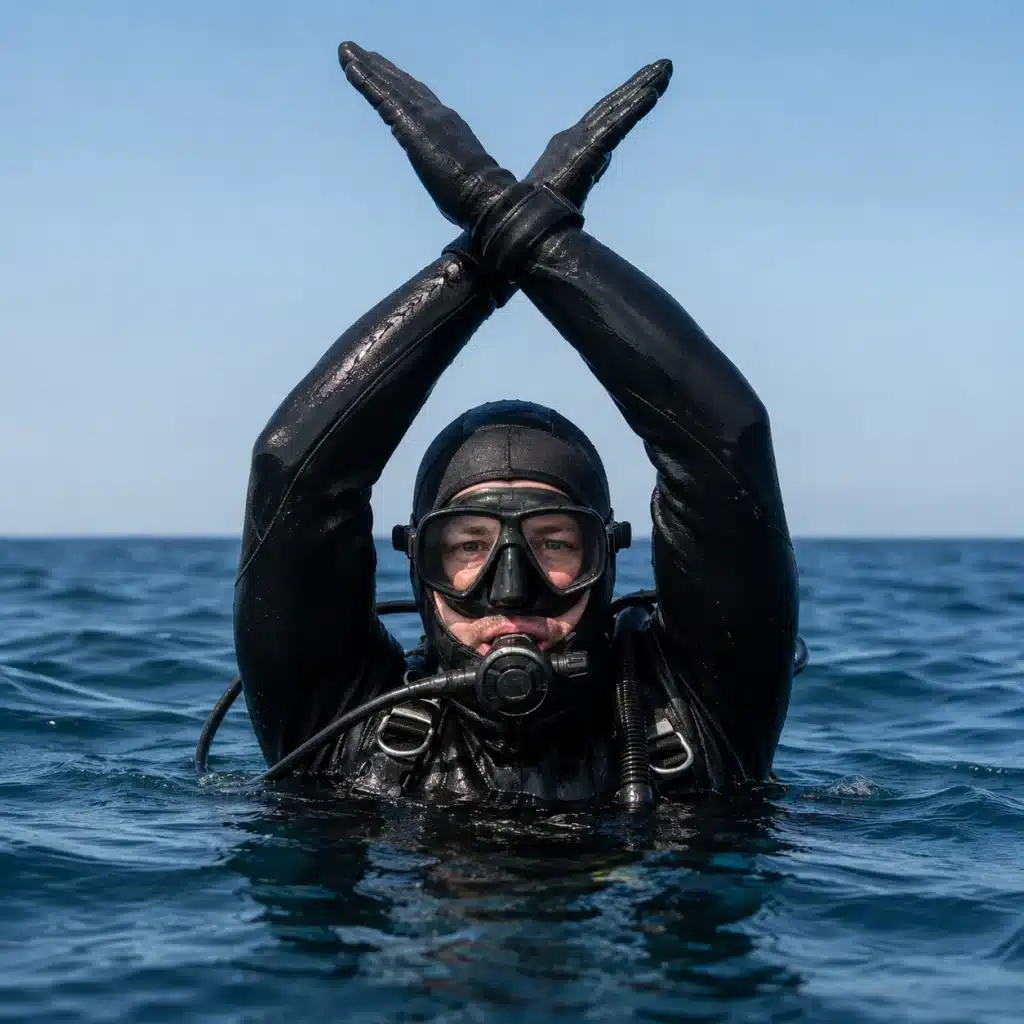
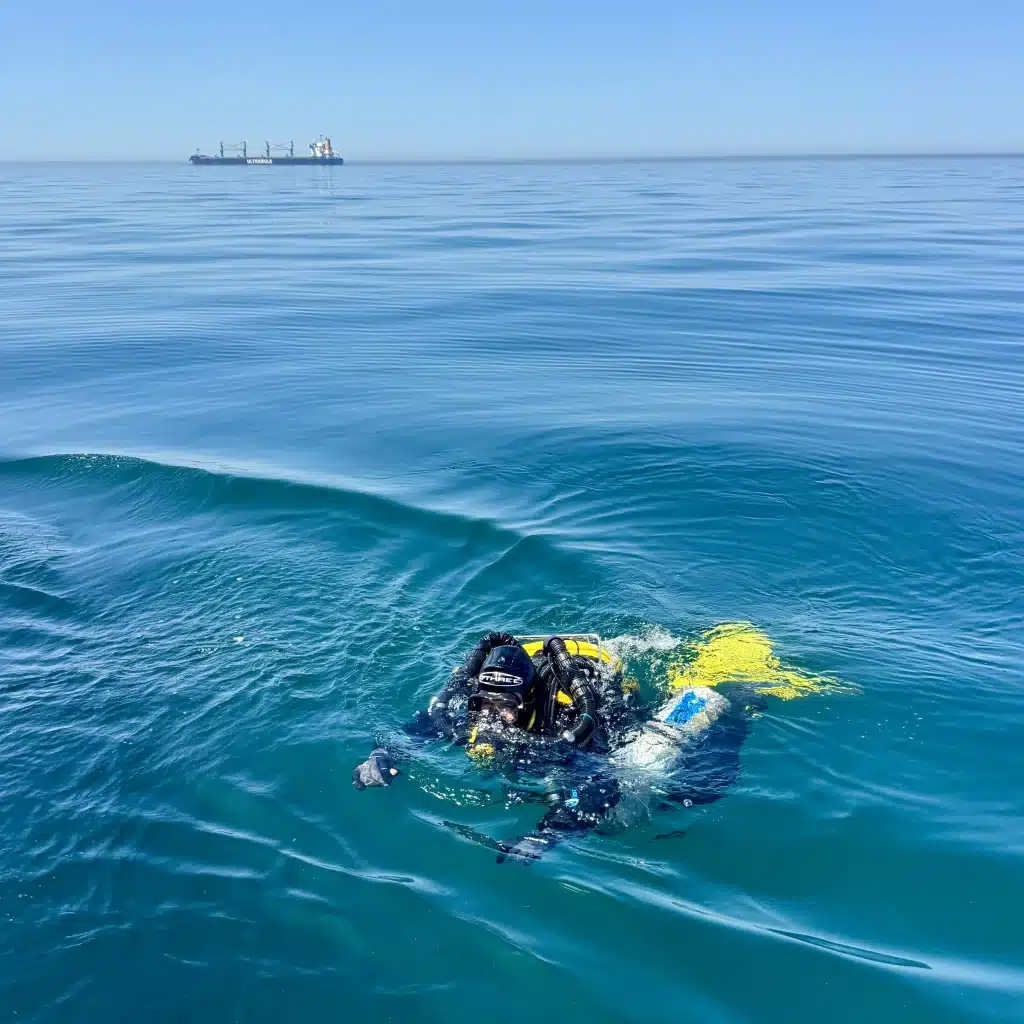
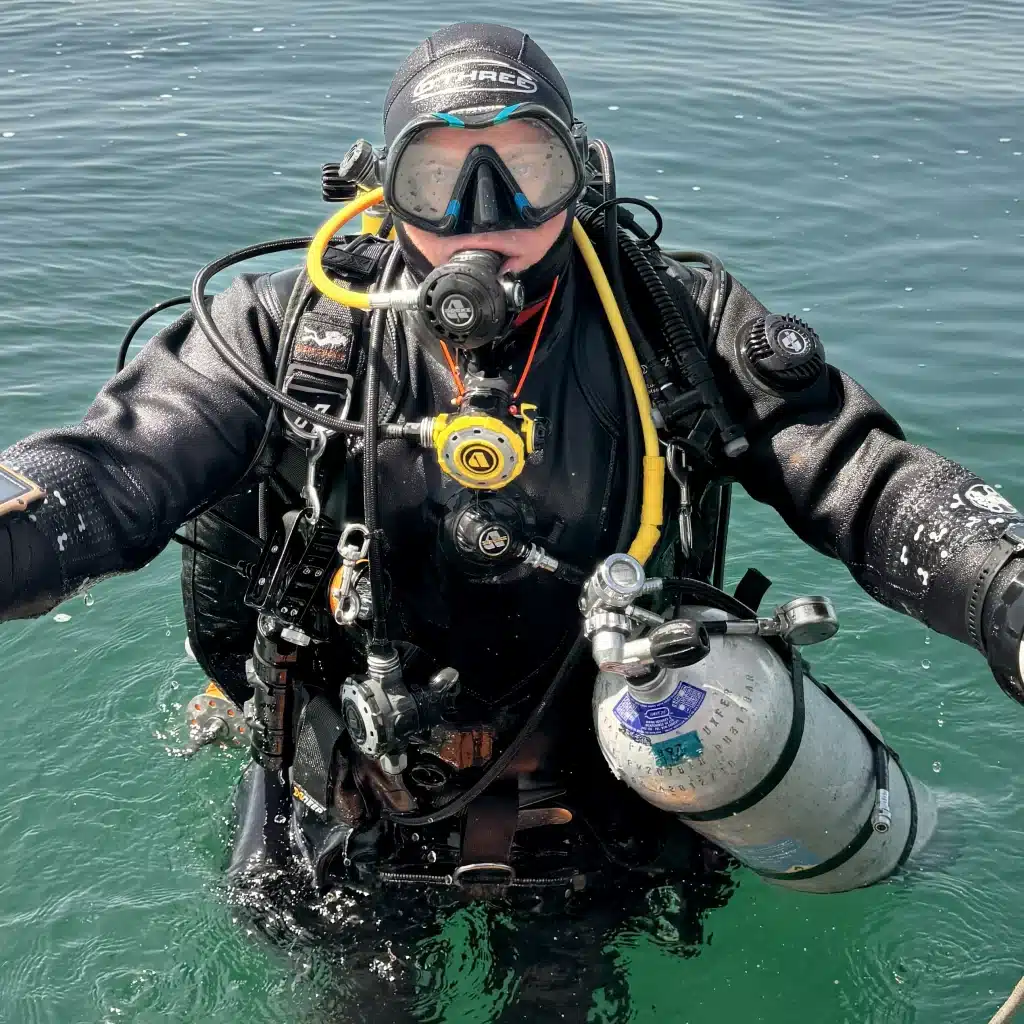
When you surface, give a big OK sign. Hand on head. Make it obvious. Not a tiny twitch in a black glove half-hidden behind your hood. From the wheelhouse, subtle hand gestures are not your friend. If you are in distress, both arms extended in a cross above your head is the signal I want to see. Do not wave with one hand. I may wave back. That would be awkward.
When the diver lift is in the water and you are stepping on, I will be looking at you. When you are ready, look at me and give a clear nod with your head. Hold on with both hands. Do not remove one hand from the rail to give a one-handed OK sign. In rougher seas, that is a fine way to end up back in the water where you so recently bobbed like a neoprene cork. A nod is enough. Nods are underrated. Civilisation would be quieter if more people used them.
Keep your regulator firmly in your gob until your backside is firmly planted on the boat. Not halfway up. Not once your fins touch metal. Not while you are still wobbling about with all the elegance of a drunk heron. On the lift, things move. The boat moves. You move. The sea moves. Gravity, as ever, remains smug.
Any diver still in the water should wait on the starboard safety line until the ascending diver is safely aboard and the lift is descending again. Do not hang around under the stern. If a diver falls off the lift and lands on top of you, nobody wins. That has happened before. We do not want to recover a concussed and unresponsive diver because someone fancied loitering in the danger zone.
Diver deployment: getting everyone onto the shot
Deployment is another place where small details matter. From the deck, everything feels obvious. From the wheelhouse, you can see how quickly it goes wrong when one diver hesitates, one turns around, one misses the shot, and someone else decides now is the perfect time to adjust a fin strap. The sea loves comedy. Skippers prefer order.
Whether you are diving solo, as a buddy pair, or as a team, you will be given the command to “Stand by.” That is your cue to get to the dive gate. Look to your left and you will see the shot coming along the starboard side. Do not stride until the skipper sounds the horn. Maverick will still have forward momentum. When the horn goes, each diver giant strides in one after the other. Like lemmings, but with more expensive computers.
Once you are in the water, do not turn around to signal OK. That is a rookie error. You will already be drifting towards the big bobber. Orientate yourself in the water. Fin towards the bobber if needed. If you turn around to wave cheerfully at the boat, you may miss the shot. You can signal OK from behind if you want – But keep looking forward. We can see you. We are literally watching you. That is rather the point.
If you miss the shot, no problem. Drift along the tail and off the small bobber. Signal clearly whether you are OK or in distress. If you are OK, we may deploy the other divers first. If you are in distress, we will come to you immediately. Panic rarely improves anything, unless your goal is to entertain Neptune.
If you miss the shot and want another attempt, we can put you back in. That is not failure. That is diving. Sometimes the tide, timing and human coordination combine to make you look daft. The trick is to stay calm, communicate clearly, and avoid converting a minor inconvenience into a rescue.
If there is slight surface current or wave chop, descend to 5 or 6 m and meet your buddy or team there. The surface can be messy. Below it, things often settle. Agree the plan before you go in. Then follow it. Wild stuff, I know.
The bigger lesson
The biggest lesson from ten days on Maverick was not one single skill. It was the relationship between all the skills. Boat handling matters. VHF matters. Radar matters. COLREGs matter. Channel VTS matters. Dive briefings matter. Shot placement matters. Recovery discipline matters. The Alfa flag matters. Clear signals matter.
And when six divers are below, all of it matters at once. That is the bit you do not fully appreciate as a diver.
From the deck, you think about your kit, your buddy, your gas, your camera, your reel, your computer, your gloves, your tea, your pasty, and whether someone has moved your bag. From the wheelhouse, the skipper is thinking about the tide, the wreck, the shot, the divers, the lift, the radio, the traffic, the weather, the next wave, the next call, the next problem, and the yacht astern behaving like it was launched from a garden centre.
It changes your perspective. It has certainly changed mine.
Ten days down, plenty still to do
All in all, I had a cracking ten days with Chris and Maverick. Diving and boating are fun. Running a dive boat properly is serious work. The banter between Chris, crew and divers, whether regulars or first-time visitors, is infectious. Everyone gets made welcome. Nobody gets left wondering what is going on. But behind the banter is a professional operation.
Dive planning. Weather calls. Tide planning. Wreck selection. VTS communication. Coastguard reporting. Diver deployment. Diver recovery. Collision avoidance. And, when needed, the firm application of “no, you are not sailing through my divers today, thank you kindly.”
There is a constant learning curve. For this boating malarkey, I still have a long road ahead.
I need roughly another 28 days at sea, including 2 proper days as skipper, plus around 750 miles and 12 night hours. Those skipper days need to be proper days too, not “I held the wheel while someone made a brew.” That makes the September Ramsgate offshore dates very important.
Ten days down. A lot learned. Plenty still to do. And if you are sailing anywhere near a dive boat with the Alfa flag flying, do everyone a favour. Look up. Keep clear. Answer your radio. And try not to become the reason a trainee skipper writes another blog post.
